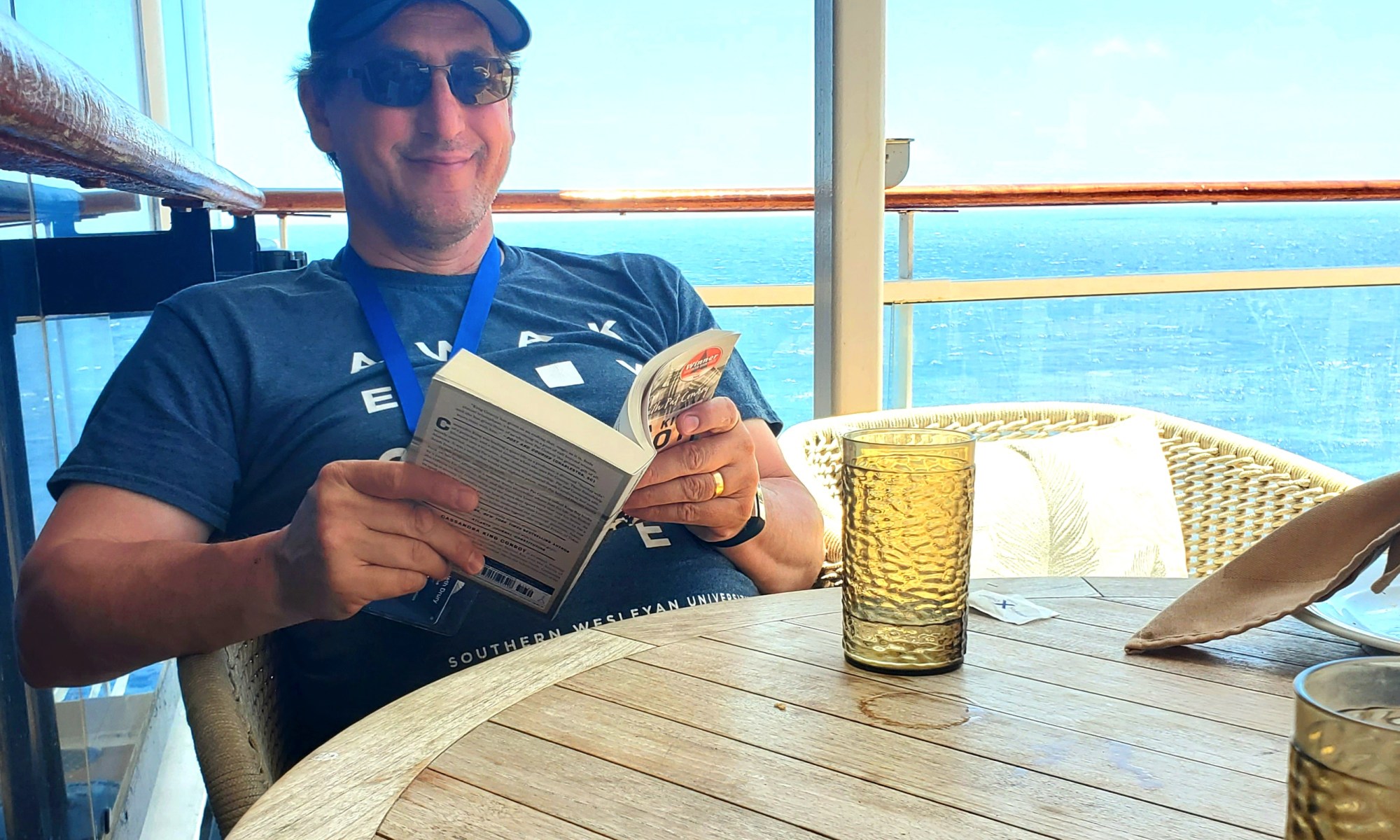
In my last post about marriage, I described how a recent cruise celebrating our 30th anniversary reminded Scott and me of some what-not-to-do advice we received when we got married. Here’s more: same cruise, different advice.
~~~~~~~~~~~
Last night after dinner, we were creeping along an upper deck and leaning head-first into a whipping wind, when a couple stopped us. We stepped close to hear them over the blustery tumult.
“Do you happen to know whether the basketball championship is playing on an outdoor screen somewhere?” the woman asked.
“It sure is,” we replied. We directed her to a screen on the top deck at the back of the ship. She was enthusiastic and happy with the news, and we added that the seating was ample and comfortable.
Her husband was standing beside her, and she spun toward him abruptly. “OK, so now YOU go up these stairs right here,” she ordered, pointing. And then turning to us, she added loudly, “and I can FINALLY get some time ALONE!”
We were surprised, wondering if maybe she was joking, but her husband seemed to be taken aback, too. He stood bewildered, with one hand on the rail and the other in the air, as if asking a question for which he couldn’t find the words. He shook his head. His wife shooed him with an exasperated upwards motion as she strode away in the opposite direction, and he slowly turned toward the stairs, the wind blowing his hair wildly.
She might have been attempting to be funny, and everyone knows the awful chagrin of making a joke that doesn’t land quite right. Regardless, the man looked embarrassed, either genuinely hurt or ashamed in front of strangers, and the moment reminded us of another useful rule a couple older and wiser had shared with us when we tied the knot 30 years ago.
Do no harm.
This rule is hardly rocket science. To our young and overly confident minds thirty-plus years ago, it had seemed laughably simplistic, like no noteworthy advice at all. Not harming one’s spouse–by insulting or embarrassing or manipulating or any other mode of meanness–should not need to be spelled out for us to know not to do it.
But our smugness didn’t last for long. In our first few years, when we were intensely self-conscious of our less-than-gracious moments and apprehensive that we’d never measure up to the (suddenly) sage saints who had offered the advice, that simple rule sometimes felt like a sledgehammer of guilt. But over time, “do no harm” has filled out and proven itself as a minimum standard of thoughtful behavior that’s worth being said. It’s so basic that it has stuck.
Without knowing the couple on the windy deck or what happened before or after our encounter with them, I can only guess that they had set out to enjoy a beautiful vacation and might have ended up spending the week in contention, hurt, and separate beds.
Realistically, every one of us has said things we regret to the people we love most. We’ve spoken rashly. We’ve been rude. It happens. We’re human. When it does, we have to make amends, which takes time, depth, energy, and focus.
For the sake of a long and happy marriage or simply to enjoy a cruise, isn’t it better not to go there at all? Of course it is. And yes, that’s easier said than done.
Consider the value of a rule, even if performance in keeping it isn’t perfect. If you consciously commit not to do harm as a principle of your marriage, think of how many choices you’ve already eliminated when the heat of the moment arrives.
Belittle him? No.
Talk bad about him to the neighbors? No.
Hide his Raisin Bran? No.
Give him the silent treatment?
. . . uhm . . . No? This one usually takes me a minute.
With a rule, you’ll already be wary in your anger not to be rude. Before you vent that exasperation carelessly, you’ll be putting on the (screeching and smoking) brakes to stop yourself.
Choosing such a rule does more than prevent pain; it also accomplishes something positive. It makes room for better experience. Just as weeding a garden gives desirable plants the space to thrive, rooting out even subtle harm as an option in your marriage creates relational space for cultuvating well-being. And less repair time in dry-dock means more cruising on the open seas.
Marriages are deep and can be complicated, and though I’m not claiming that this magic pill can fix everything, I do believe that it’s essential. Why? Because spouses are in the best position of anyone on the planet to promote either harm or wellbeing in one another’s lives, and only one of those choices nourishes a marriage.
It may cost you some hot pride and the fleeting vindication of a moment, but I doubt you’ll regret it. Rip harm out of the playbook, do good instead, and see what happens.
 VIBRANCY